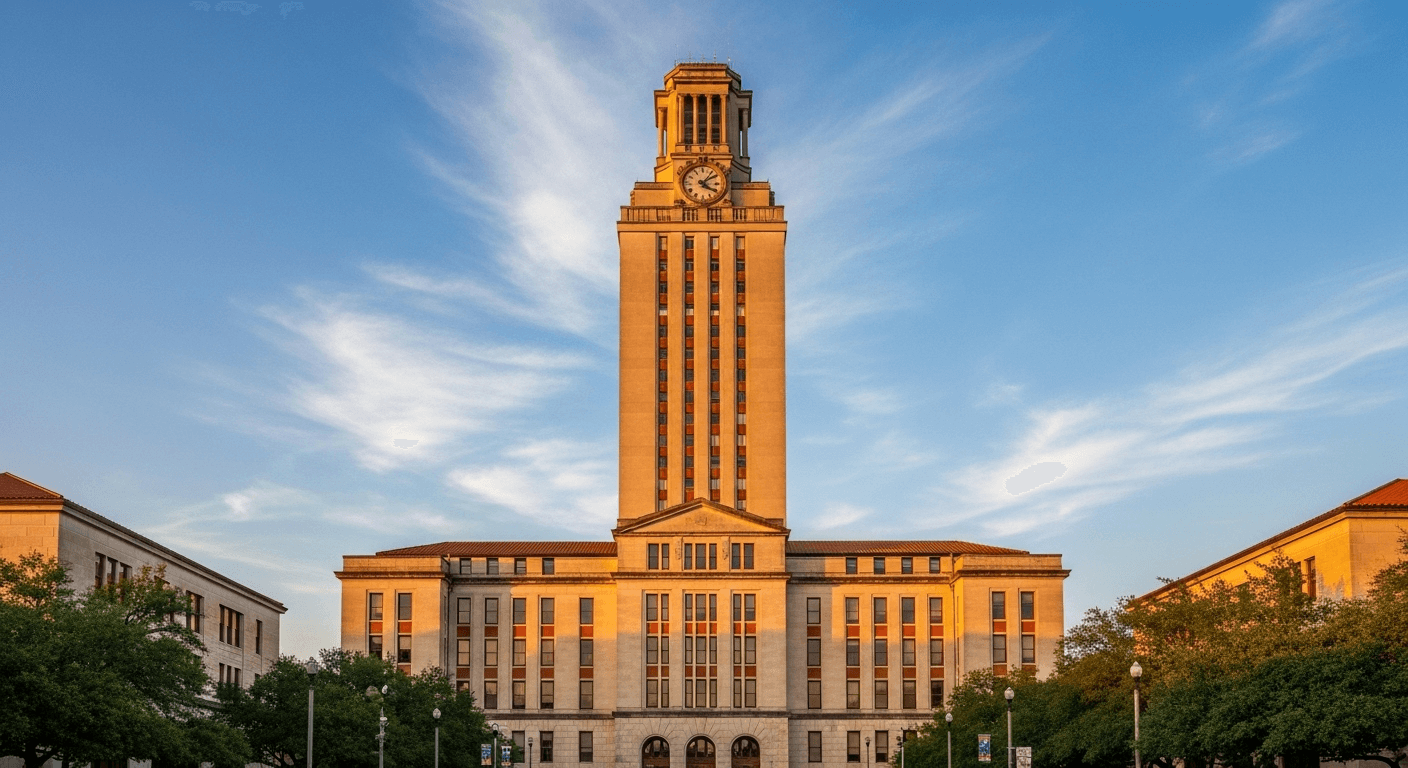
By UT college
UT Austin tuition by college and major
UT Austin charges a base undergraduate tuition rate ($11,688/year resident, $44,908/year non-resident) plus an additional college-specific surcharge called differential tuition. The differential ranges from about $200/semester (Natural Sciences) to about $1,800/semester (Computer Science). Differential tuition is the same dollar amount for resident and non-resident students. The Texas residency pathway only reduces the residency-sensitive portion, but that portion is the same dollars across all colleges, so the savings of $33,220/year applies uniformly.
Browse by college
Each guide includes the in-state and out-of-state rate, the differential tuition explanation, admissions selectivity context, expected career outcomes, and how the residency pathway changes the math for non-resident students.
Cost comparison across UT colleges
| College | In-State (per year) | Out-of-State (per year) | Savings from residency |
|---|---|---|---|
| Computer Science (CSDS) | $15,300 | $53,500 | $38,200 |
| Cockrell School of Engineering | $14,500 | $51,800 | $37,300 |
| McCombs School of Business | $14,200 | $51,200 | $37,000 |
| Moody College of Communication | $12,350 | $45,900 | $33,550 |
| College of Natural Sciences | $12,100 | $45,500 | $33,400 |
| College of Fine Arts | $11,950 | $45,300 | $33,350 |
| College of Liberal Arts | $11,688 | $44,908 | $33,220 |
| College of Education | $11,688 | $44,908 | $33,220 |
Why differential tuition exists
Different colleges have different cost structures. Engineering and Natural Sciences require expensive laboratory space and equipment. McCombs uses small-section case-method instruction with industry practitioners. Computer Science competes with industry and other top-tier programs for faculty, which drives faculty compensation. Differential tuition is the mechanism by which UT funds those college-specific costs without taxing students in less expensive colleges to subsidize the more expensive ones.
The residency pathway works for every UT college
The Texas residency pathway under Texas Education Code §54.052 applies identically regardless of which UT college the student is in. The 12-month domicile clock, the property pathway, and the petition process are the same. The savings is also the same dollar amount (about $33,220/year) because differential tuition is paid by residents and non-residents alike. The residency reclassification only changes the residency-sensitive portion of base tuition.
Internal transfer between UT colleges
Some UT students enter through one college and transfer internally. Internal transfer to McCombs and to Computer Science is highly selective; transfer to Engineering is also competitive. Liberal Arts and Natural Sciences are the most common starting points for students who later transfer. Differential tuition adjusts to the destination college upon transfer.
Talk to Luke
Your situation is specific. Get a written answer.
The site covers the general case. If your circumstances do not quite fit — divorce, military, scholarship interactions, late timing, prior denial — send a message. Luke replies personally, usually within one business day.
Or send a message and Luke will reply in writing: