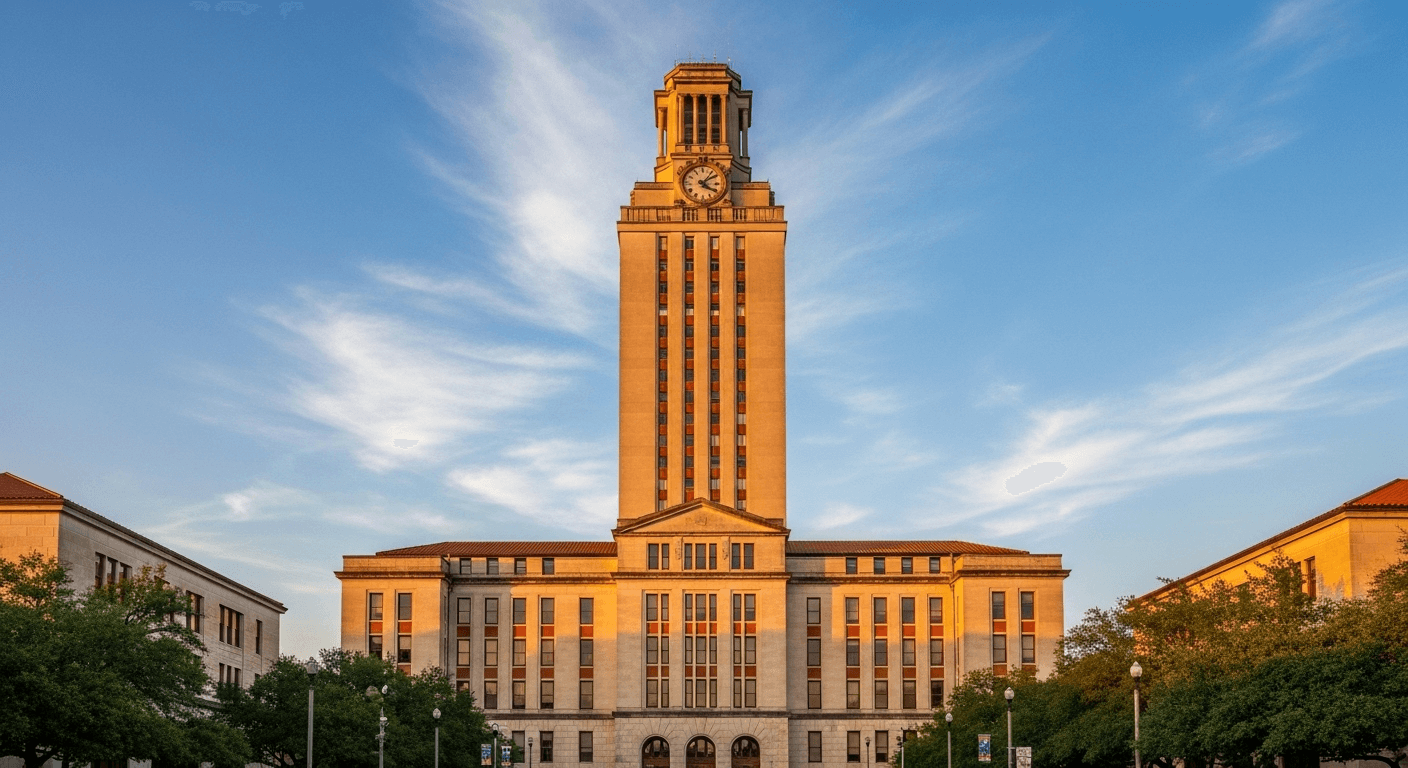
UT Austin · Class of 2030
UT Austin Class of 2030
UT Austin Class of 2030 enters Fall 2026 and graduates May 2030. Expected class size: ~8,500-9,000 freshmen. Application priority deadline: November 1, 2025; regular deadline December 1, 2025. Expected acceptance rate: ~31% overall, ~8-13% non-resident. Year 1 tuition: $11,688 in-state, $44,908 non-resident. Texas residency pathway pursued during year 1 saves approximately $99,660 over years 2-4.
Class of 2030 timeline (Fall 2026 entry)
| Date | Event |
|---|---|
| August 1, 2025 | ApplyTexas opens |
| October 1, 2025 | FAFSA opens for 2026-27 |
| November 1, 2025 | UT Austin priority deadline + Forty Acres Scholars deadline |
| December 1, 2025 | UT Austin regular deadline (final) |
| January 15, 2026 | FAFSA priority deadline |
| February 2026 | Forty Acres Scholars finalist interviews; first wave admit notifications |
| March-April 2026 | Second wave admit notifications; admitted students events |
| May 1, 2026 | National Decision Day; submit enrollment deposit |
| May-June 2026 | Orientation registration; housing application; for residency pathway families, begin Texas property acquisition |
| August 2026 | If pursuing residency pathway: move to Texas; obtain Texas DL/registration/voter |
| August 26, 2026 (approximate) | First day of UT classes (Class of 2030 starts) |
| August-September 2026 | Year 1: tuition paid as non-resident if applicable |
| Fall 2027 (approximate) | If 12-month clock complete: petition for residency reclassification |
Class of 2030 expected admission profile
| Metric | Expected Value |
|---|---|
| Overall acceptance rate | ~31% |
| Non-resident acceptance rate | ~8-13% |
| Class size | ~8,500-9,000 freshmen |
| Texas Top 10% admits | ~75% of class (Texas residents) |
| Out-of-state admits | ~10% of class (cap) |
| Admitted middle 50% GPA | 3.8-4.0 unweighted |
| Admitted middle 50% SAT | 1320-1500 |
| Top quartile (McCombs/CS/ECE) | 4.0 GPA, 1500+ SAT |
Class of 2030 four-year cost projection
| Scenario | 4-Year Tuition | 4-Year COA (incl. housing) |
|---|---|---|
| Texas resident (4 years in-state) | ~$48,000 | ~$140,000-$160,000 |
| Non-resident full sticker (4 years OOS) | ~$190,000-$210,000 | ~$300,000-$340,000 |
| Non-resident with residency pathway (year 2 reclassification) | ~$90,000-$95,000 | ~$200,000-$230,000 |
| Non-resident with $7,500/yr merit + residency pathway | ~$60,000-$65,000 | ~$170,000-$200,000 |
The Class of 2030 application strategy for out-of-state families
Spring junior year (Spring 2025)
- Take SAT or ACT; assess scores against UT target profile
- Identify UT as target school; identify major preferences
- Visit UT Austin campus if possible
- Build extracurricular profile
Summer before senior year (Summer 2025)
- Substantive summer activity related to target major (internship, research, business activity)
- Begin essay brainstorming and drafting
- Engage college counselor or independent advisor
- Research scholarships (Forty Acres, college-specific merit, outside)
- Begin residency pathway planning if applicable: identify Texas property options, consult Texas REALTOR and CPA
Senior year fall (Fall 2025)
- Submit ApplyTexas by November 1 priority deadline
- Submit Forty Acres Scholars application by November 1 (if academic profile supports)
- Complete college-specific honors applications (BHP, Plan II, etc.)
- Submit essays for all targeted majors
- Send SAT/ACT scores and official high school transcript
Senior year winter-spring (Winter-Spring 2026)
- Submit FAFSA by January 15
- Complete UT Honors and Scholarship Application (HSA) after admission
- Compare offers from all schools; financial planning
- Visit admitted students events (Texas Admit Day, etc.)
- Decide by May 1 and submit enrollment deposit
Summer 2026 (before freshman year)
- Register for orientation
- Apply for on-campus housing
- If pursuing residency pathway: acquire Texas property + establish documentary set
- Move to Austin; obtain Texas driver's license, vehicle registration, voter registration
- Begin building local community for student arrival
For Class of 2030: the residency pathway window
Year 1 to Year 2 reclassification
Out-of-state Class of 2030 students who pursue the Texas residency pathway typically: (1) acquire Texas property in summer 2026 and move; (2) establish documentary set (Texas DL, vehicle reg, voter reg) by September 2026; (3) maintain Texas domicile through Year 1 (Fall 2026 - Spring 2027); (4) file residency reclassification petition in Summer 2027 for Fall 2027 (Year 2 of UT enrollment); (5) approved petition reclassifies to in-state tuition for years 2-4. Total savings over years 2-4: approximately $99,660.
Frequently asked questions
What is the UT Austin Class of 2030?
When should my student apply for UT Austin Class of 2030?
What is the expected acceptance rate for UT Austin Class of 2030?
What will UT Austin tuition be for Class of 2030?
What is the four-year financial picture for Class of 2030?
How should my student prepare for Class of 2030 admission?
Should we pursue the Texas residency pathway for Class of 2030?
When are housing applications due for Class of 2030?
Talk to Luke
Your situation is specific. Get a written answer.
The site covers the general case. If your circumstances do not quite fit — divorce, military, scholarship interactions, late timing, prior denial — send a message. Luke replies personally, usually within one business day.
Or send a message and Luke will reply in writing: