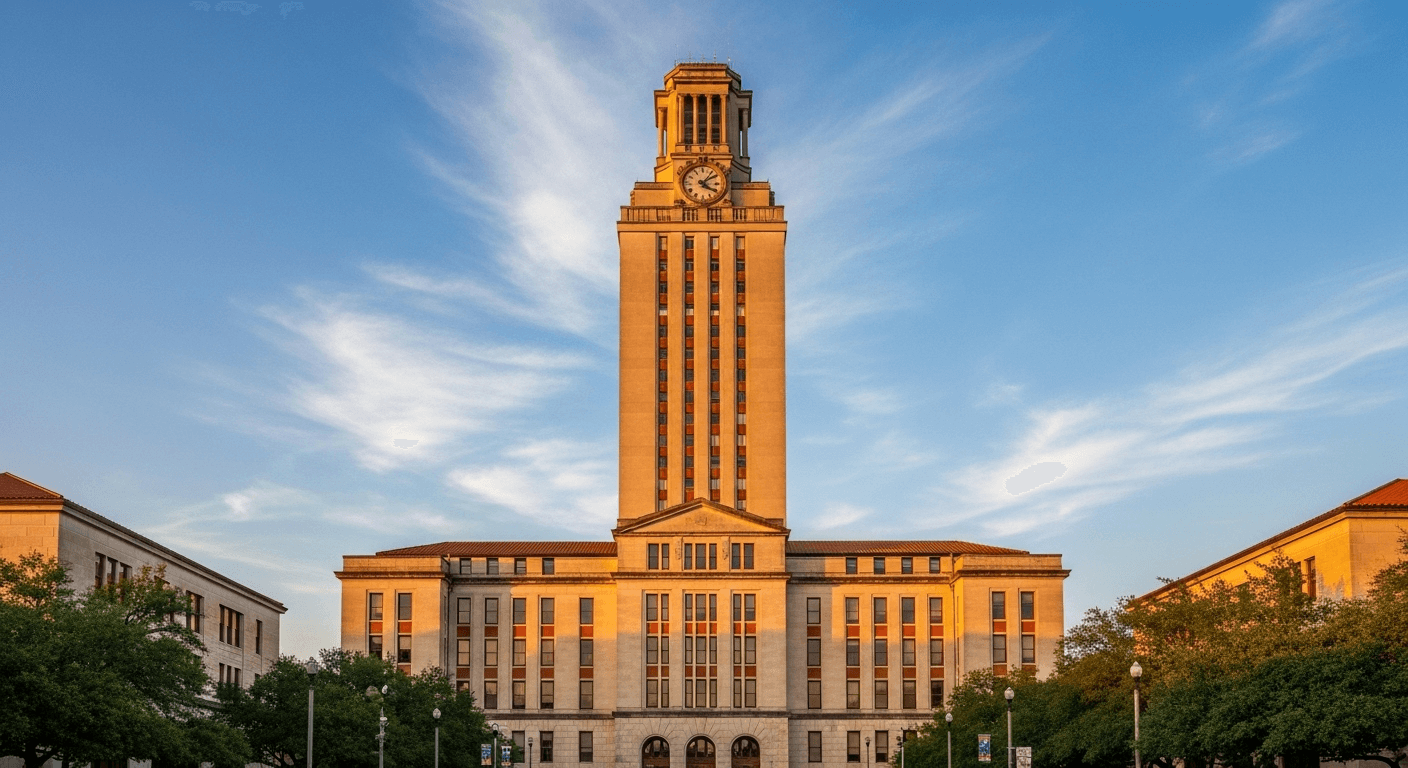
UT Austin housing
The UT Austin Housing Guide for Parents
UT Austin parents have three housing choices for their student: on-campus residence halls (~$11,000-$15,000/year plus required meals at most halls), off-campus apartments (~$13,000-$25,000/year for a private or shared bedroom), or family-owned property (variable). For out-of-state families, the family-owned condo route is the only option that also unlocks the Texas residency pathway, which saves approximately $33,220/year on UT tuition. About 25% of UT undergraduates live on campus; the rest are in West Campus, Hyde Park, Riverside, and East Austin.
The three housing options at UT Austin
Option A: On-campus residence halls
UT operates 14 residence halls with approximately 7,400 beds, housing about 25% of the undergraduate population. Halls vary significantly in cost, layout, and culture.
| Hall | Approx. Annual Cost | Notes |
|---|---|---|
| Jester East / West | $11,000-$12,500 | Largest halls; central location near most classes; older buildings; double rooms common. |
| Kinsolving | $11,500-$13,000 | Women-only; central; older but well-maintained. |
| San Jacinto | $12,000-$13,500 | Close to engineering classes; mid-cost mix of singles and doubles. |
| Roberts / Prather | $12,000-$13,500 | Smaller halls; community-focused; popular with Plan II Honors students. |
| Honors Quad (Andrews, Carothers, Blanton) | $13,000-$14,500 | For Plan II and other honors students; selective placement. |
| Almetris Duren | $14,000-$15,500 | Newer renovation; popular with upperclassmen; apartment-style. |
| Whitis Court | $14,500-$15,500 | Newer; apartment-style with kitchens; no required meal plan. |
Most residence halls require a meal plan (~$5,000-$6,000/year additional). Whitis Court, Almetris Duren, and a few other apartment-style halls do not require it.
UT housing applications open in February of the year before enrollment. Apply as early as possible; demand exceeds supply for several halls. The Housing Portal in MyStatus handles the application.
Option B: Off-campus apartments
The majority of UT students live off campus, primarily in West Campus and surrounding neighborhoods. Five neighborhoods to know:
West Campus
The densest student-housing neighborhood, immediately west of campus from 23rd to 29th Street. Filled with purpose-built student apartment buildings (Skyloft, Lark, The Standard, Rise West Campus, Nine63, 26 West, The Castilian, Moontower, and many more). Per-bedroom rents in furnished four-bedroom shared apartments: $1,000-$1,800/month including most utilities. Studios and one-bedrooms: $1,500-$2,500/month. 5-15 minute walks to class.
Hyde Park
North of campus, more residential. Mix of older houses and a smaller selection of newer apartment complexes along Avenue A, Avenue B, and the cross streets. Quieter culture than West Campus. Rents typically 10-15% lower than West Campus for comparable space. 15-30 minute walks or 8-12 minute bike rides to campus.
North Campus and the Drag
The strip between Guadalupe Street and Speedway, north of MLK Boulevard. Smaller inventory than West Campus but more diverse (older single-family conversions, mid-rise condos, a few newer projects). Slightly cheaper than West Campus on a per-square-foot basis. 5-15 minute walks to campus.
Downtown Austin high-rises
Higher-end option for families with budget for amenities and a metro lifestyle. The Austonian, Sienna, The Independent, and 360 are common choices. HOA dues are high ($700-$2,400/month). 20-35 minute walks to campus or quick bike/scooter rides.
East Austin (78702, 78722)
South-of-MLK East Austin offers small houses, duplexes, and townhomes at slightly longer commutes (7-15 minutes by car). Strong neighborhood character and food scene. Better fit for upperclassmen with cars or those who can bike to class.
Option C: Family-owned condo (the residency pathway angle)
For out-of-state families, buying a condo near UT for the student is uniquely valuable because it simultaneously solves two problems: housing for four years and the Texas residency requirement that unlocks in-state tuition.
The Texas residency pathway under Texas Education Code §54.052 requires 12 continuous months of Texas domicile before the term's census date. The most common qualifying activity for out-of-state families is acquiring Texas real property where the student lives. The 12-month residency clock running on the property converts the student to a Texas resident, saving approximately $33,220/year on tuition for the remaining three years at UT (typical pathway: pay out-of-state for year 1, in-state for years 2-4).
Cumulative savings over the typical pathway: approximately $99,660. That figure usually meets or exceeds the family's four-year carrying cost on a $400K-$500K West Campus condo.
Representative condo carrying costs
For a $475,000 West Campus 2-bedroom condo with 25% down at a 6.5% mortgage, $550/month HOA, $9,000/year property tax (post-homestead exemption), and standard insurance:
- Annual cash outflow: approximately $42,000-$45,000/year
- Of which: principal pay-down ≈ $11,000/year (recovered on sale)
- Net annual cost: approximately $30,000-$34,000/year
- Compare to off-campus apartment rent for a comparable unit: $25,000-$30,000/year
- Differential: ~$5,000-$10,000/year more expensive than renting
- Tuition savings from residency pathway: ~$$33,220/year (starting year 2)
- Net result over four years: family-owned condo wins by approximately $80,000-$110,000 vs renting + paying out-of-state tuition
- Plus property appreciation, typically $20,000-$60,000+ over a four-year hold
This is why most out-of-state UT families with the capital pursue the property pathway. Full condo-selection guide here.
Housing recommendations by family situation
If you are a Texas resident
Compare on-campus and West Campus apartments on cost, community fit, and lifestyle preference. Costs are roughly comparable; the choice is mostly about social experience.
If you are out-of-state and not pursuing the residency pathway
On-campus year 1 is the most common parental recommendation for the structured community. Move to West Campus apartments for years 2-4. Total housing cost: $50,000-$80,000 over four years.
If you are out-of-state and pursuing the residency pathway
Buy a condo near UT. The four-year financial math works for most families with enough capital for a 25% down payment. The condo also gives you a real-estate position in a growing market. See the condos near UT guide.
If you have multiple kids likely to attend UT
Buying makes even more sense. The property carries forward to the second student, who can also use it for the residency pathway. The math becomes substantially more favorable.
Frequently asked questions
Is on-campus housing required for first-year students at UT Austin?
What is the best UT Austin residence hall?
How much does an off-campus apartment near UT cost?
Where do UT Austin parents recommend their students live?
Is West Campus safe?
Can my student live with me if I buy a condo in Austin?
What is the cheapest way to house a UT Austin student?
Talk to Luke
Your situation is specific. Get a written answer.
The site covers the general case. If your circumstances do not quite fit — divorce, military, scholarship interactions, late timing, prior denial — send a message. Luke replies personally, usually within one business day.
Or send a message and Luke will reply in writing: