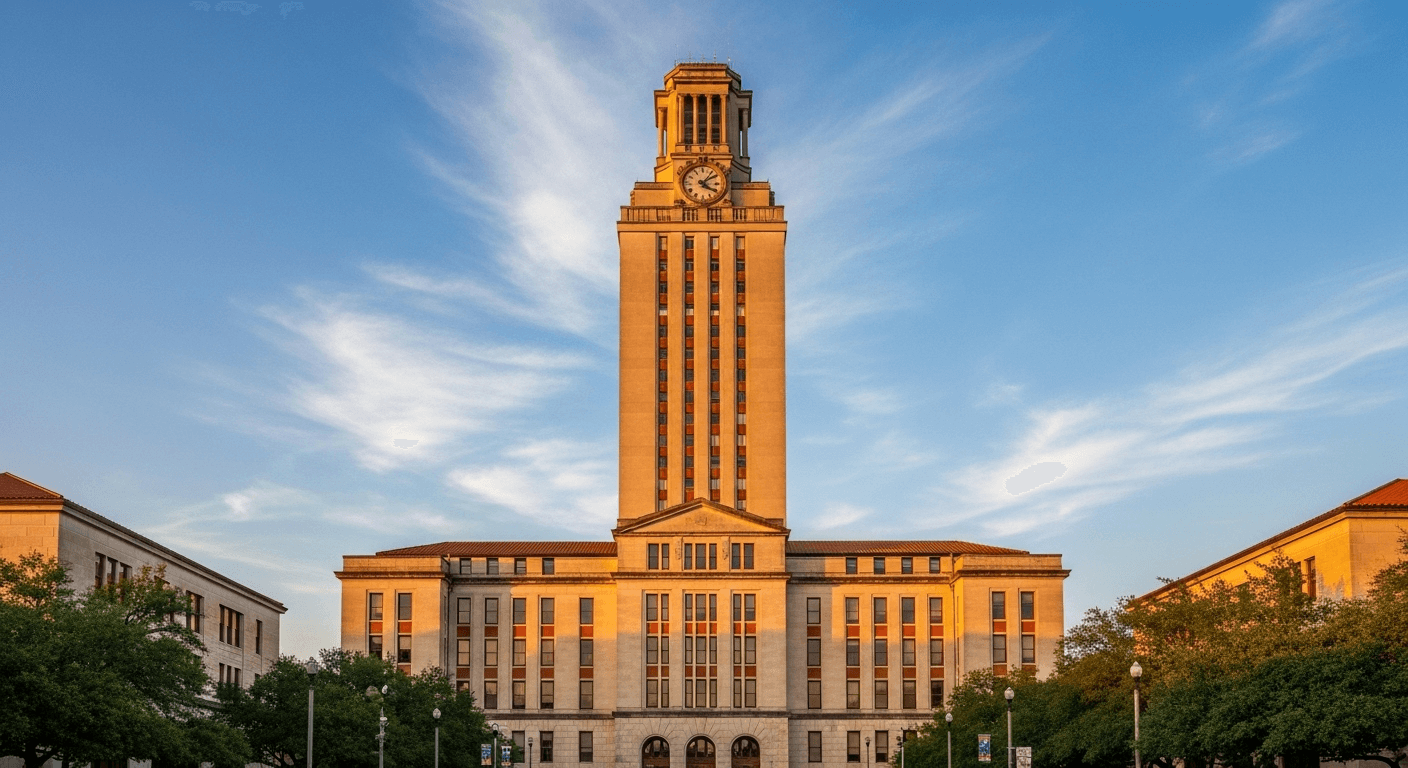
UT Austin · Out-of-state students
UT Austin Out-of-State Students
Approximately 10% of UT Austin's undergraduate population is out-of-state (~4,200 students). Non-resident tuition is $44,908/year; in-state is $11,688/year. OOS acceptance rate is approximately 8-13%, materially lower than the 31% overall rate due to Texas's 10% non-resident cap. The Texas residency pathway saves approximately $33,220/year after 12 months of qualifying Texas domicile.
The out-of-state landscape at UT Austin
| Metric | Value |
|---|---|
| OOS share of undergraduate population | ~10% (~4,200 students) |
| OOS acceptance rate | ~8-13% |
| Overall UT acceptance rate | ~31% |
| OOS tuition (2025-26) | $44,908 |
| In-state tuition (2025-26) | $11,688 |
| Annual savings via residency pathway | $33,220 |
| OOS-friendly seats per year | ~1,000-1,100 freshman admits |
Why UT Austin out-of-state acceptance is so competitive
Three structural facts compress the OOS admit pool:
- Texas Top 10% Rule. Texas high school graduates in the top 6% are auto-admitted to UT, consuming approximately 75% of in-state seats.
- 10% non-resident cap. Texas state policy limits non-resident enrollment to approximately 10% of the entering class.
- Holistic review for remaining seats. The remaining ~25% of in-state seats (non-Top 10% Texas residents) plus the 10% non-resident allocation go through holistic review. OOS applicants compete in this small competitive pool.
The five pillars of an OOS UT experience
1. Admission
- Acceptance rate: ~8-13% (vs 31% overall)
- Admitted profile: 3.9-4.0 GPA, top 5% class rank, SAT 1450+, substantive extracurricular depth
- Most selective colleges: CS (~5-8% OOS), McCombs (~5-8% OOS), Cockrell ECE (~7-10% OOS)
- More accessible UT colleges: Liberal Arts, Education, some Natural Sciences majors
- See: UT Austin acceptance rate
2. Tuition and cost
- OOS tuition: $44,908/year
- Four-year OOS total: ~$179,632 at sticker
- Cost of attendance OOS (with housing, meals, books): ~$80K-$90K/year
- Four-year COA total OOS: ~$320K-$360K at sticker
- See: UT Austin 4-year cost
3. The Texas residency pathway
- Annual savings: ~$33,220 after reclassification
- Three-year savings: ~$99,660 (year 2-4 at in-state rate)
- How: 12 months of qualifying Texas domicile + documentary set + petition
- Property pathway: Rule #3 (parent-owned, student-occupied) or Rule #4 (LLC rental)
- See: Texas residency rules
4. Financial aid and scholarships
- Federal aid (Pell, federal loans): available to OOS based on FAFSA
- Institutional merit scholarships: $2K-$15K typical for OOS; Forty Acres Scholars full-ride ~15/year
- NOT available to OOS: Texas Advance Commitment, Texas Empowerment (residency-restricted; available after pathway)
- See: Scholarships for OOS and Financial aid for OOS
5. Long-term outcomes
- Career placement: strong; UT alumni network is among the largest of any US university
- Top employers: Apple, Google, Goldman, Deloitte, ExxonMobil, plus Austin tech and Texas corporate
- OOS alumni concentration: Bay Area, NYC, DC, LA after graduation; many also remain in Austin
- See: Graduate outcomes
Top OOS feeder states for UT Austin
Find your origin state for a tailored guide:
California · New York · Illinois · Florida · Georgia · New Jersey · Maryland · Virginia · Massachusetts · Connecticut · Washington · Colorado · Arizona · Tennessee · Michigan · North Carolina · Pennsylvania · Ohio
Full list of 31 origin state guides at /by-state.
Why families choose UT Austin from out of state
- Top-tier academics at moderate cost: top-30 nationally, top-10 public, with materially lower sticker than peer top publics (Berkeley, Michigan, UVA)
- The residency pathway: 12-month pathway to in-state tuition that no other top public flagship offers
- Austin location: tech capital, music industry, state government, mild winters, growing metro
- Specific program strength: McCombs (top 10 business), CS (top 10), Cockrell (top 10-15), Plan II Honors, Forty Acres Scholars
- Texas residency unlocks downstream benefits: Texas medical school in-state rates, Texas state-tax exit, broader Texas economic opportunity
The first six months for an OOS UT student
- Summer before freshman year: If pursuing residency pathway, acquire Texas property + establish documentary set; if not pursuing, plan move logistics
- August (move-in): Move to Austin; obtain Texas driver's license, register vehicle, register to vote (if pursuing pathway)
- September-October: Orient to campus, build initial social network, identify clubs and student organizations
- October-November: Begin career exploration (career fair attendance, alumni networking); start building professional relationships
- November-December: Complete first semester; assess academic and social fit
- January-February: Begin internship search if applicable; continue residency documentary maintenance
Frequently asked questions
How many out-of-state students are at UT Austin?
How does UT Austin out-of-state tuition compare to other top public universities?
Is UT Austin hard to get into for out-of-state students?
What is the UT Austin residency pathway?
How do most out-of-state UT students pay for school?
What majors are most popular among UT out-of-state students?
Where do UT Austin out-of-state students come from?
Is UT Austin worth it for out-of-state students?
Talk to Luke
Your situation is specific. Get a written answer.
The site covers the general case. If your circumstances do not quite fit — divorce, military, scholarship interactions, late timing, prior denial — send a message. Luke replies personally, usually within one business day.
Or send a message and Luke will reply in writing: