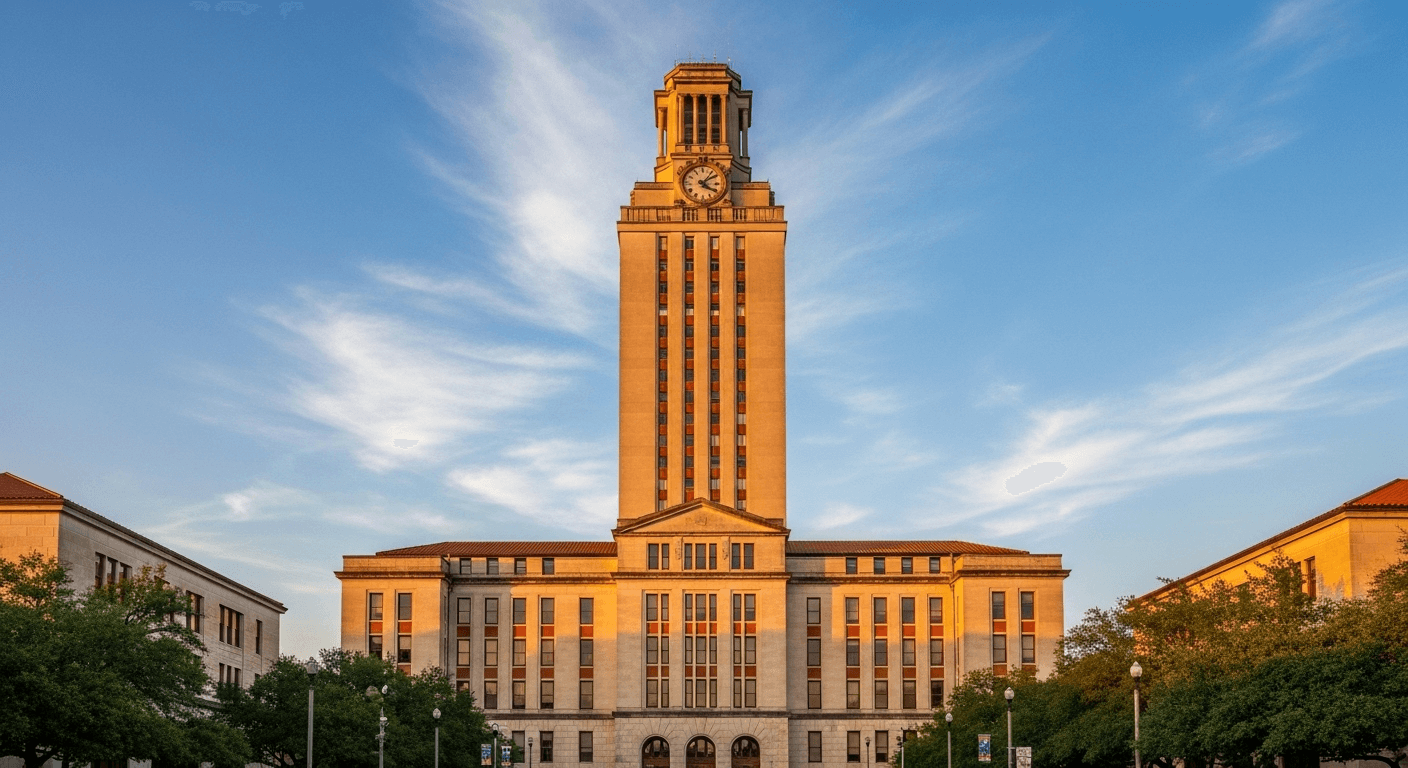
UT Austin · Pre-med pathway
UT Austin Pre-Med: Pathway to Medical School
UT Austin does not have a "pre-med major." Pre-med is a pathway pursued alongside any major; the Health Professions Office (HPO) provides advising and committee-letter support. Standard prerequisites: General Chemistry, Organic Chemistry, Biochemistry, General Biology, General Physics, Calculus, English, Psychology, Sociology. UT medical school applicant pool: ~50-55% admission rate (higher than national average ~41%). Average matriculating profile: 3.7+ GPA, 511+ MCAT. The Texas residency pathway saves out-of-state pre-med families approximately $33,220/year through undergrad, with surplus 529 capacity available for medical school.
UT Austin pre-med at a glance
UT Austin has produced thousands of physicians over its history. The pre-med pathway runs through the Health Professions Office (HPO), the College of Natural Sciences (where most pre-med students major), and the surrounding Austin medical ecosystem (Dell Medical School, St. David's, Ascension Seton, Baylor Scott & White).
UT does NOT have a pre-med major. Students pursue pre-med while majoring in:
- Biology, Biochemistry, Chemistry, Neuroscience: the traditional pre-med majors with the most overlap with medical school prerequisites
- Public Health, Nutritional Sciences, Human Development: pre-med-friendly majors with applied health focus
- Plan II Honors: highly competitive pre-med environment with liberal arts depth
- Any other major: Music, Art History, Government, Business, Engineering, etc. Medical schools accept any major if prerequisites are completed and GPA is strong
The pre-med prerequisites at UT
| Prerequisite | UT Course | Typical Timing |
|---|---|---|
| General Chemistry I + II | CH 301 + 302 + labs | Freshman year |
| Organic Chemistry I + II | CH 320M + 320N + labs | Sophomore year |
| Biochemistry | CH 339K or BCH 369 | Junior year |
| General Biology I + II | BIO 311C + 311D + labs | Freshman/sophomore year |
| General Physics I + II | PHY 302K + 302L + labs | Sophomore/junior year |
| Calculus I | M 408C or 408K | Freshman year |
| English Composition | RHE 306 + lit elective | Freshman year |
| Biostatistics | BIO 320 / SDS 328M | Junior year |
| Psychology | PSY 301 | Any year |
| Sociology | SOC 302 | Any year |
Honors versions of many prerequisites (Honors Chemistry, Honors Organic Chemistry, Honors Biology) are available for strong students and strengthen medical school applications by demonstrating rigorous course choice.
The four-year pre-med timeline at UT
Freshman year
- General Chemistry I + II
- General Biology I + II
- Calculus I
- English Composition
- Major-specific courses or core requirements
- Begin clinical exposure (volunteering, shadowing)
- Join UT Pre-Med Society and Health Professions Office
Sophomore year
- Organic Chemistry I + II
- General Physics I + II
- Major courses
- Increase clinical and research engagement
- Begin MCAT preliminary review
Junior year
- Biochemistry
- Biostatistics
- Psychology, Sociology (if not completed)
- MCAT preparation; sit for MCAT in spring or summer
- Build relationships with science faculty for letters of recommendation
- Apply to summer research or clinical programs
Senior year
- Complete major
- Apply to medical school (AMCAS opens May before senior year; primary applications due in summer; secondary applications and interviews fall through spring)
- Request HPO committee letter
- Senior thesis or capstone project (if applicable)
Medical school admission outcomes from UT Austin
UT Austin pre-med applicants achieve admission rates above the national average. Approximate outcomes:
- Overall UT applicant admission rate: ~50-55% per cycle (vs national ~41%)
- Applicants with 3.7+ GPA and 510+ MCAT: ~70-75% admission rate
- Applicants with 3.8+ GPA and 515+ MCAT: ~85%+ admission rate
- Texas medical school placement: Dell Medical, UT-Houston (McGovern), UT-San Antonio (Long), UTMB-Galveston, Baylor College of Medicine, and Texas Tech are common destinations
- Out-of-state placement: applicants with strong profiles also attend top out-of-state programs (Harvard, Hopkins, Stanford, UCSF, UPenn, Duke, NYU)
The Texas medical school advantage for UT undergrads
Texas operates seven public medical schools (Dell Medical at UT Austin, McGovern at UT-Houston, Long at UT-San Antonio, UTMB Galveston, Texas Tech in Lubbock and El Paso, Texas A&M College of Medicine). Texas medical schools admit approximately 90% of their students from Texas applicants under the Texas Medical and Dental Schools Application Service (TMDSAS) priority system. For Texas residents (including those who establish residency through the UT undergrad residency pathway), this provides a significantly easier path to medical school than out-of-state applicants face.
The Texas residency pathway for pre-med families
Two compounding benefits for pre-med families
An out-of-state pre-med family who establishes Texas residency during UT undergraduate enrollment sees: (1) UT undergrad tuition drops from $44,908/year to $11,688/year, saving approximately $99,660 over 3 years; (2) Student becomes Texas resident for TMDSAS Texas medical school admission (the priority pool), opening Dell Medical and other Texas medical schools at in-state rates ($30-45K/year vs $60-75K/year out-of-state). Combined undergrad + medical school savings: approximately $200,000-$300,000.
Pre-med advising and support at UT
- Health Professions Office (HPO): pre-med advising, committee letter coordination, application support, mock interviews
- UT Pre-Med Society: student organization with shadowing connections, MCAT study groups, alumni mentorship
- Freshman Research Initiative: pre-med-friendly research projects starting freshman year
- UTeach Pre-Med: for pre-med students interested in teaching alongside their medical career
- Dell Medical School research labs: open to UT undergrads as research assistants
- Austin clinical opportunities: St. David's, Ascension Seton, Baylor Scott & White, free clinics
Pre-med vs other UT majors: cost comparison
Pre-med students at UT typically major in Biology, Biochemistry, or Neuroscience within the College of Natural Sciences. Natural Sciences tuition at UT is approximately $12,100/year resident and $45,500/year non-resident, very close to the base rate. Lab fees add approximately $500-$1,500/year for pre-med specifically. MCAT prep is an additional one-time cost of $1,500-$3,500.
Medical school cost considerations
- Texas medical school in-state tuition: ~$22,000-$30,000/year (after Texas residency)
- Texas medical school out-of-state tuition: ~$45,000-$65,000/year
- Top private medical schools: $65,000-$75,000/year tuition
- Four-year medical school cost (TX in-state): ~$200,000-$280,000 including living expenses
- Federal student loans available for medical school: $40,500-$47,167/year (Stafford) plus Grad PLUS up to cost of attendance
- Public service loan forgiveness (PSLF): available for physicians working in qualifying public service settings
Frequently asked questions
Does UT Austin have a pre-med major?
What is the UT Austin Health Professions Office?
What are the pre-med prerequisites at UT Austin?
What GPA do I need for medical school admission from UT Austin?
What MCAT score do I need from UT?
How does UT Austin compare to Texas A&M for pre-med?
What is Dell Medical School and does UT undergrad help with admission?
What clinical and research opportunities exist for pre-med at UT?
What is the UT Austin medical school admission rate?
Talk to Luke
Your situation is specific. Get a written answer.
The site covers the general case. If your circumstances do not quite fit — divorce, military, scholarship interactions, late timing, prior denial — send a message. Luke replies personally, usually within one business day.
Or send a message and Luke will reply in writing: