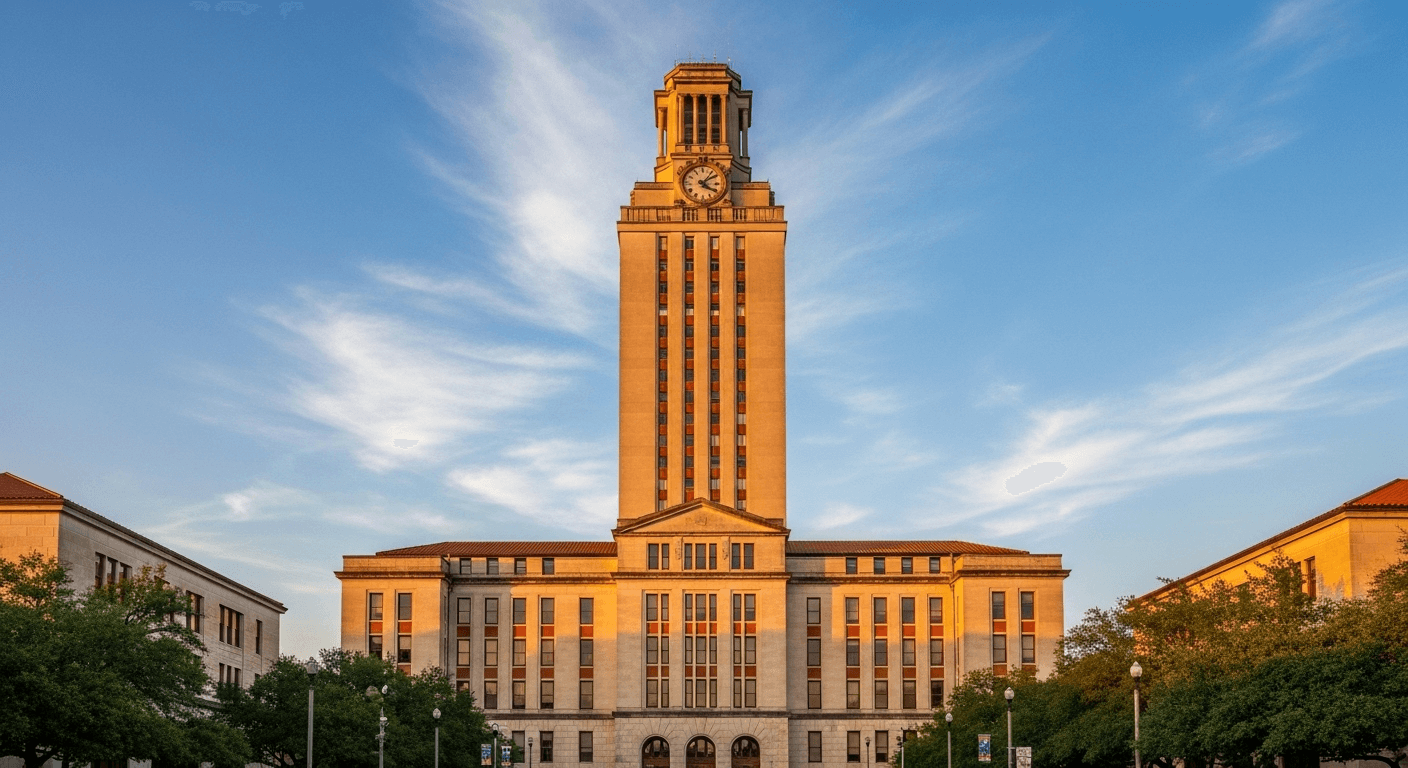
UT Austin · Rankings
UT Austin Rankings
UT Austin ranks top 30 nationally (US News), top 10 among US public universities, top 50 globally (Times Higher Ed, QS). UT is a member of the prestigious Association of American Universities (62 member research institutions). Per-major rankings vary: McCombs Business top 10, Computer Science top 10-12, Cockrell Engineering top 10-15, with many liberal arts and natural sciences departments in the top 20-30.
UT Austin in major ranking systems
| Ranking System | UT Austin Rank | Notes |
|---|---|---|
| US News National Universities (2026) | #32 | Top 30-40 range over recent years |
| US News Public Universities (2026) | #10 | Consistently top 10-15 |
| Times Higher Education World (2026) | #48 | Top 50 globally |
| QS World University Rankings (2026) | #67 | Top 75 globally |
| Forbes America's Top Colleges | #27 | Top 30 overall |
| Princeton Review Best Colleges | Listed (no numeric) | "Best Value" recognition |
| Niche Best Colleges | #26 | Top 30 |
| Wall Street Journal/THE | #40 | Top 50 |
| Washington Monthly | #36 | Includes social mobility metrics |
UT Austin among top US public universities
| Public University | US News National Rank | US News Public Rank |
|---|---|---|
| UC Berkeley | #15 | #1 |
| UCLA | #15 | #2 |
| Michigan | #20 | #3 |
| Virginia | #24 | #4 |
| North Carolina-Chapel Hill | #22 | #5 |
| Florida | #28 | #6 |
| UC San Diego | #28 | #7 |
| Georgia Tech | #33 | #8 |
| UC Davis | #28 | #9 |
| UT Austin | #32 | #10 |
| Texas A&M | #51 | #12 |
| Ohio State | #43 | #11 |
| Wisconsin-Madison | #39 | #13 |
| Illinois Urbana-Champaign | #35 | #11 |
Rankings approximate; exact placement varies by edition. UT sits in the top tier of US public universities, alongside Michigan, UVA, and UNC for overall reputation.
UT Austin per-major and per-college rankings
McCombs School of Business
- US News Undergrad Business: top 10 (currently #5-#7)
- Bloomberg Undergrad Business: top 10
- Specific specialties: Accounting #1-#3 nationally, Management Information Systems #3-#5, Marketing top 10, Finance top 15
- Forbes Top Business Schools: top 15
Computer Science (CSDS)
- US News Undergrad CS: top 10-12 (currently #9-#11)
- CSRankings (research-focused): top 10
- Specific specialties: Programming Languages #2 nationally, Theory top 10, AI top 12, Systems top 15
Cockrell School of Engineering
- US News Undergrad Engineering: top 10-15
- Specific disciplines: Petroleum Engineering #1-#3 nationally, Chemical Engineering top 10, Civil Engineering top 10, Biomedical Engineering top 15, Mechanical Engineering top 15, Aerospace top 10, Electrical and Computer Engineering top 12
Architecture
- DesignIntelligence Undergrad Architecture: top 10
- Strong programs: Architecture, Urban Studies, Interior Design
Liberal Arts
- Plan II Honors: distinctive nationally; among top interdisciplinary honors programs
- Specific departments: Government top 10 (LBJ School policy connections), History top 20, English top 20, Linguistics top 15, Economics top 20, Psychology top 25
Moody College of Communication
- US News Undergrad Communication: top 20
- Specific specialties: Radio-TV-Film top 10, Journalism top 15, Advertising top 15
College of Natural Sciences
- Mathematics: top 15
- Physics: top 15
- Chemistry: top 20
- Biology, Biochemistry: top 25
- Neuroscience: top 20
Music (Butler School of Music)
- US News Undergrad Music: top 30
- Specific strengths: Performance (especially Jazz Studies, Brass, Composition)
Other notable rankings
- Pharmacy: top 10
- Education: top 25 graduate; undergraduate education program competitive
- Nursing: top 50
- Law: top 15 (UT School of Law is among the strongest in the country)
- Public Affairs (LBJ School): top 15
- MBA (McCombs): top 20
How to interpret rankings
What rankings measure well
- Academic resources: faculty quality, research output, library and lab capacity
- Outcomes: graduation rate, job placement, average starting salary
- Selectivity: acceptance rate, SAT/ACT range, GPA range
- Reputation: peer assessment scores from other universities
What rankings measure poorly
- Fit: the right school for you may not be the highest-ranked school
- Teaching quality: faculty research output and undergraduate teaching quality often diverge
- Cost-effectiveness: rankings rarely emphasize cost-to-value
- Major-specific: aggregate rankings can hide enormous differences between strong and weak departments at the same school
- Social mobility and access: some rankings emphasize this; many do not
UT Austin rankings vs cost comparison
UT Austin's rankings, weighed against cost, produce one of the strongest value propositions among US universities. UT's top-25 academic ranking combined with its in-state tuition (significantly lower than peer top-25 publics like Michigan, Virginia, UCLA) makes UT the best public university value for Texas residents and (through the residency pathway) for out-of-state families who establish residency.
For an out-of-state family choosing between UT and a higher-ranked private (e.g., USC, NYU, Northwestern at $66K+/year), UT's top-25 academic credentials at $44K out-of-state or $11.6K after Texas residency produces materially better cost-to-value than the higher-ranked private.
Frequently asked questions
What is UT Austin's ranking?
Where does UT Austin rank among public universities?
Is UT Austin a top-tier university?
Why does UT Austin rank lower than some peer universities?
What is UT Austin's ranking by major?
How does UT Austin compare to top private universities in rankings?
Has UT Austin's ranking changed in recent years?
Talk to Luke
Your situation is specific. Get a written answer.
The site covers the general case. If your circumstances do not quite fit — divorce, military, scholarship interactions, late timing, prior denial — send a message. Luke replies personally, usually within one business day.
Or send a message and Luke will reply in writing: