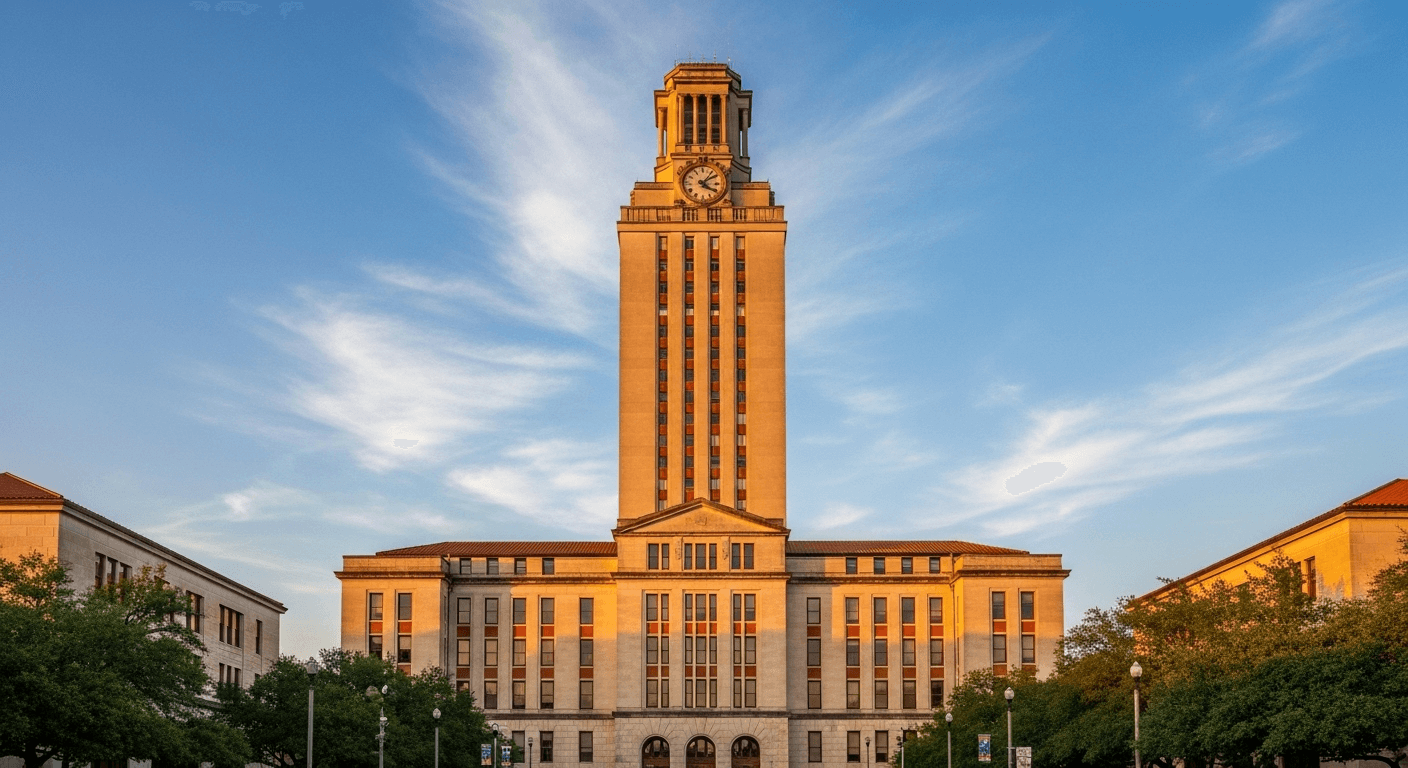
UT Austin comparison · vs Michigan
UT Austin vs University of Michigan
UT Austin in-state tuition is $11,688/year vs Michigan in-state at $17,700/year. Out-of-state at UT is $44,908/year vs Michigan out-of-state at $57,400/year. For out-of-state families, the Texas residency pathway can convert the UT non-resident rate to the resident rate in 12 months, making UT after residency the cheapest of the four classifications.
Summary
UT Austin and the University of Michigan are flagship public universities in the top 25 nationally. Michigan generally has stronger national prestige; UT has competitive programs in business (McCombs), computer science, and engineering. Michigan in-state at ~$17,700 is significantly more expensive than UT in-state at $11,688, meaning Texas residency through the UT pathway can produce a final cost cheaper than attending Michigan as a Michigan resident.
Cost comparison
| Tuition + Required Fees | UT Austin | Michigan | Difference |
|---|---|---|---|
| In-state (resident) | $11,688 | $17,700 | UT cheaper by $6,012 |
| Out-of-state (non-resident) | $44,908 | $57,400 | UT cheaper by $12,492 |
| UT after Texas residency | $11,688 | vs Michigan in-state: $6,012 cheaper at UT |
Michigan is more expensive in both classifications. Michigan in-state at $17,700/year is about $6,000 more than UT in-state. Michigan out-of-state at $57,400 is about $12,500 more than UT out-of-state. For out-of-state students, UT after residency ($11,688) is about $6,000/year cheaper than Michigan in-state, meaning the residency pathway makes UT cheaper than Michigan even compared to Michigan's home rate.
Where UT Austin wins
- Lower in-state tuition ($11,688 vs Michigan's $17,700)
- McCombs Business School direct undergrad admission (Michigan Ross is junior-year application)
- Austin tech industry plus Texas alumni network
- Plan II Honors interdisciplinary program
- Warmer weather and outdoor lifestyle vs Ann Arbor winters
- Larger overall undergraduate population with broader major selection
Where Michigan wins
- Michigan generally outranks UT in overall national prestige
- Ross School of Business reputation is strong (when admitted to its junior-year program)
- Engineering at Michigan (especially Mechanical, Aerospace, Industrial) ranks higher
- Pre-med pipeline to top medical schools is stronger from Michigan
- Football tradition and Big Ten athletics culture
- Michigan Engineering co-op program is among the strongest in the country
Program comparison
For Business: McCombs (UT) admits all admitted undergrads to the business school directly. Ross (Michigan) is a junior-year application with about 50% acceptance from the Michigan undergrad applicant pool. For Engineering: Michigan generally outranks UT in Mechanical, Aerospace, Industrial, and Computer Engineering rankings. UT Cockrell is competitive in Petroleum, Chemical, and Biomedical. For CS: UT and Michigan rank similarly (both in top 15). For Liberal Arts: Michigan generally outranks UT in many disciplines; UT counters with Plan II Honors.
Admissions comparison
Michigan acceptance rate is about 18%, more selective than UT's ~30%. Both heavily favor in-state students by total class composition. Michigan has a holistic admissions process with strong emphasis on rigor and extracurricular depth. UT for in-state students uses the Top 10% Rule for automatic admission; for out-of-state students, admission is holistic but heavily weighted to academic profile.
Culture and campus
Ann Arbor is a classic college town of about 120,000 surrounding the Michigan campus. The Big Ten athletics culture (football especially) is woven into student life. Winters are long and cold. Austin is a much larger metro (~2.5M) and the Texas capital, with year-round outdoor weather, music industry, tech industry, and state government as the surrounding context. The cultures are quite different; choice often comes down to climate and city size preferences.
The Texas residency angle
The Texas residency pathway makes UT dramatically cheaper than Michigan for out-of-state families. UT after residency at $11,688/year vs Michigan out-of-state at $57,400/year is a difference of nearly $46,000/year in tuition. Even compared to Michigan in-state at $17,700, UT after residency is $6,000/year cheaper. There is no equivalent fast-track Michigan residency pathway for out-of-state college students.
Frequently asked questions
Is Michigan better than UT Austin?
Which is cheaper, UT after residency or Michigan in-state?
Can my Michigan student attend UT and pay in-state tuition through the residency pathway?
What about Michigan football and Big Ten culture?
Does Michigan Ross beat McCombs?
Talk to Luke
Your situation is specific. Get a written answer.
The site covers the general case. If your circumstances do not quite fit — divorce, military, scholarship interactions, late timing, prior denial — send a message. Luke replies personally, usually within one business day.
Or send a message and Luke will reply in writing: