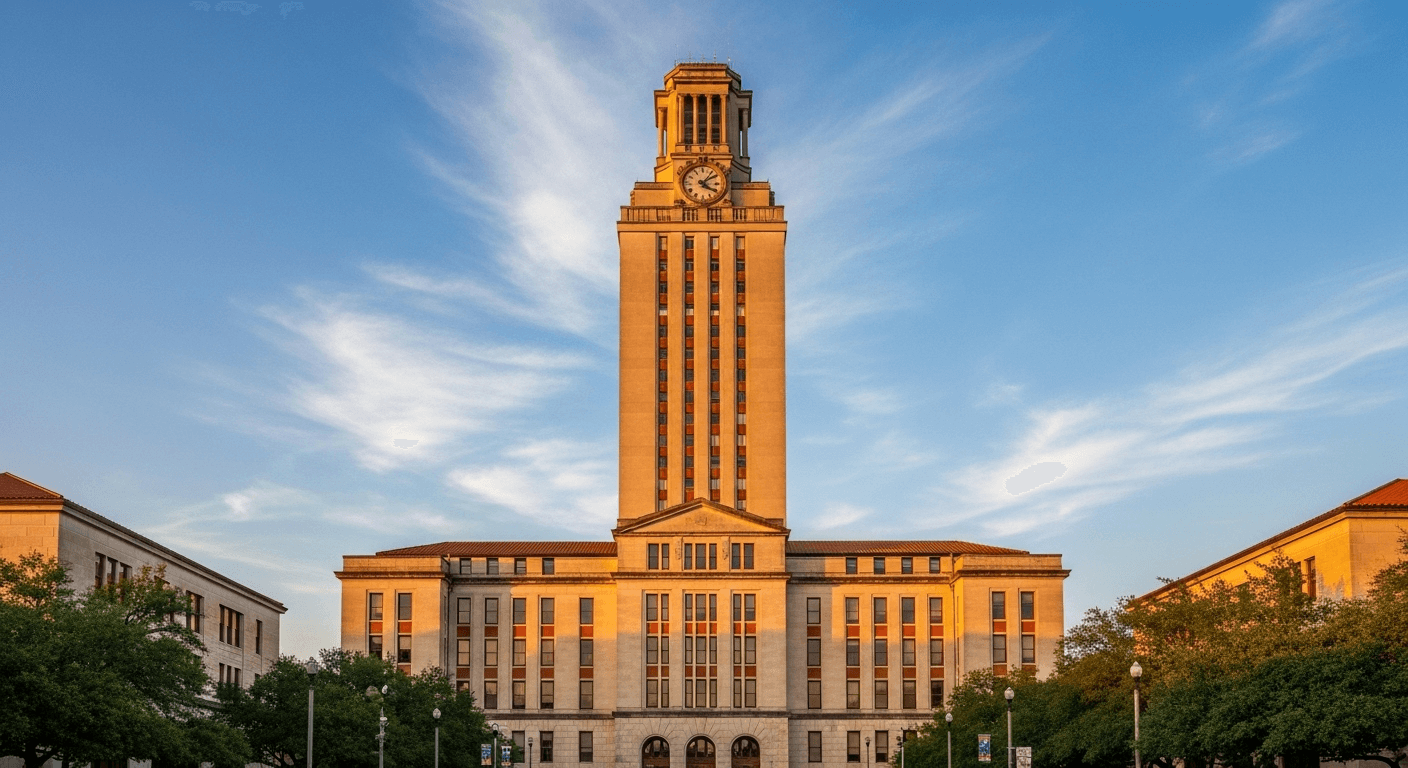
UT Austin comparison · vs Rice
UT Austin vs Rice University
UT Austin in-state tuition is $11,688/year vs Rice in-state at $60,000/year. Out-of-state at UT is $44,908/year vs Rice out-of-state at $60,000/year. For out-of-state families, the Texas residency pathway can convert the UT non-resident rate to the resident rate in 12 months, making UT after residency the cheapest of the four classifications.
Summary
UT Austin and Rice are both top Texas universities with different funding models and academic personalities. Rice is a top-20 private research university (smaller, more selective, more expensive); UT is a top-public flagship (larger, more accessible, much cheaper). Rice has a strong reputation for engineering, computer science, music, and architecture. Cost: Rice sticker is ~$60,000/year; UT in-state is $11,688; UT non-resident is $44,908. With UT Texas residency pathway, UT is dramatically cheaper than Rice even with substantial Rice merit aid.
Cost comparison
| Tuition + Required Fees | UT Austin | Rice | Difference |
|---|---|---|---|
| In-state (resident) | $11,688 | $60,000 | UT cheaper by $48,312 |
| Out-of-state (non-resident) | $44,908 | $60,000 | UT cheaper by $15,092 |
| UT after Texas residency | $11,688 | vs Rice in-state: $48,312 cheaper at UT |
Rice tuition is approximately $60,000/year regardless of residency (private). With Rice merit aid (typical $10-25K/yr for strong applicants) and need-based aid (substantial for families under $200K AGI), Rice can become comparable to UT non-resident. With UT Texas residency pathway, UT becomes dramatically cheaper than Rice in any scenario.
Where UT Austin wins
- UT in-state at $11,688 is dramatically cheaper than Rice sticker at $60,000
- UT after Texas residency at $11,688 saves $40,000+/year over Rice with typical Rice merit aid
- McCombs Business at UT outranks Rice Jones School of Business at undergraduate level (Rice Jones is primarily MBA)
- UT alumni network in Texas is much larger than Rice alumni network
- UT campus social life is broader and more vibrant than Rice's small intimate campus
- UT Austin location offers more internship and industry access
Where Rice wins
- Rice ranks higher than UT on overall prestige (top 20 vs top 30)
- Rice undergraduate experience is more intimate (~1,000 students per class vs UT's ~8,500)
- Rice has strong residential college system (similar to Oxford/Cambridge)
- Rice Engineering (specifically Computer Science, Bioengineering) ranks competitively with UT
- Rice has strong need-based aid (no loans for under $200K AGI)
- Houston Medical Center adjacency provides unique pre-med opportunities
Program comparison
For Computer Science: Rice and UT are both top 10-12 nationally. For Engineering: Rice has strong Bioengineering and Computer Engineering; UT Cockrell has stronger Petroleum and Civil. For Business: McCombs significantly outranks Rice Jones at undergraduate level. For Music: Rice Shepherd is one of the top conservatories; UT Butler is competitive but generally one tier below. For Pre-Med: Rice has the Houston Medical Center adjacency advantage.
Admissions comparison
Rice acceptance rate ~9%; UT ~31% overall (~8-13% non-residents). Rice is more selective on aggregate. Rice admissions emphasizes intellectual fit and demonstrated character; UT for non-residents is similarly selective for top programs.
Culture and campus
Rice is in central Houston, an urban campus with the Texas Medical Center adjacency. Rice culture is intellectually focused, small (~7,500 undergrad), with the distinctive residential college system. UT Austin is in urban Austin, much larger (~42,000 undergrad), with music, tech, and government as the surrounding context. For students who want a small intimate experience, Rice; for students who want a large urban research university, UT.
The Texas residency angle
For Texas families admitted to both Rice and UT, the comparison depends on Rice merit aid. With Rice need-based aid for under-$200K AGI families, Rice can be comparable to UT in-state. For higher-income families, UT in-state ($11,688) is dramatically cheaper than Rice ($60,000) sticker. For out-of-state families, UT Texas residency pathway makes UT dramatically cheaper than Rice in any scenario.
Frequently asked questions
Is Rice better than UT Austin?
Is Rice more expensive than UT for in-state students?
My Houston student got into Rice and UT McCombs. Which?
Does Rice need-based aid make it competitive with UT?
What about the residential college system at Rice?
Talk to Luke
Your situation is specific. Get a written answer.
The site covers the general case. If your circumstances do not quite fit — divorce, military, scholarship interactions, late timing, prior denial — send a message. Luke replies personally, usually within one business day.
Or send a message and Luke will reply in writing: