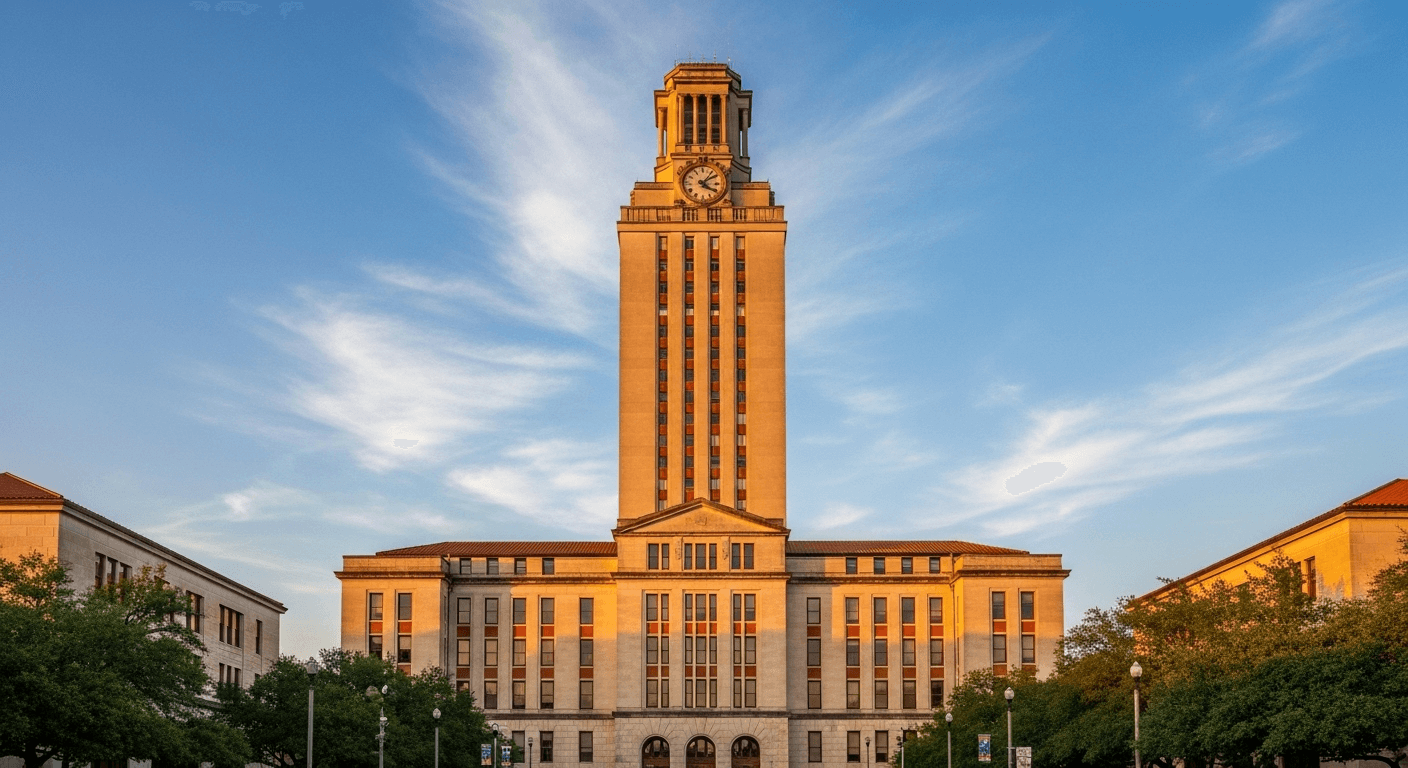
UT Austin comparison · vs A&M
UT Austin vs Texas A&M University
UT Austin in-state tuition is $11,688/year vs A&M in-state at $13,600/year. Out-of-state at UT is $44,908/year vs A&M out-of-state at $40,200/year. For out-of-state families, the Texas residency pathway can convert the UT non-resident rate to the resident rate in 12 months, making UT after residency the cheapest of the four classifications.
Summary
UT Austin and Texas A&M are the two flagship public universities of Texas, sharing the Permanent University Fund endowment and similar in-state tuition. UT Austin generally ranks higher in business (McCombs), liberal arts (Plan II Honors), and computer science; A&M traditionally ranks higher in engineering and agricultural sciences. In-state tuition is nearly identical ($11,688 UT vs ~$13,600 A&M). The schools have distinct campus cultures: UT urban-Austin and politically diverse, A&M traditional College Station with conservative leanings and the Aggie cultural identity.
Cost comparison
| Tuition + Required Fees | UT Austin | A&M | Difference |
|---|---|---|---|
| In-state (resident) | $11,688 | $13,600 | UT cheaper by $1,912 |
| Out-of-state (non-resident) | $44,908 | $40,200 | A&M cheaper by $4,708 |
| UT after Texas residency | $11,688 | vs A&M in-state: $1,912 cheaper at UT |
UT Austin in-state is about $1,900/year cheaper than A&M for residents. UT out-of-state is about $4,700/year more expensive than A&M out-of-state. The Texas residency pathway applies identically to both schools (Texas Education Code §54.052 covers all Texas public universities).
Where UT Austin wins
- McCombs Business School consistently ranks higher than A&M Mays Business (top 10 vs top 30)
- Plan II Honors interdisciplinary program is distinctive nationally
- Computer Science direct admit highly competitive; UT CS recruits at the top tier of national CS programs
- Liberal Arts breadth and depth, especially languages, philosophy, history
- Urban Austin location with extensive internship pipeline in tech, government, music industry
- Stronger pipeline to top-tier MBA and law school admissions
Where A&M wins
- Engineering (Dwight Look College) ranks ahead of UT Cockrell in several disciplines (petroleum, agricultural, civil)
- Texas Aggie Corps of Cadets and ROTC programs are nationally prominent
- Veterinary medicine school (one of two in Texas; UT does not have one)
- Bonfire Memorial, Aggie Ring, and tradition culture is a distinguishing feature many families value
- Slightly larger total undergraduate population (~65,000 vs UT's ~42,000)
- College Station offers a more traditional college-town experience vs UT's urban setting
Program comparison
For Business: McCombs (UT) outranks Mays (A&M) by a wide margin in national rankings (US News, Bloomberg) and in recruiting outcomes. Top investment banks, consulting firms, and tech companies recruit at McCombs at a higher tier. For Engineering: A&M Look College outranks UT Cockrell in petroleum (#1 in the US for decades), agricultural, and civil. UT Cockrell outranks A&M in chemical, computer, and biomedical. For Computer Science: UT outranks A&M by a wide margin, with UT CS recruiting alongside Stanford, MIT, CMU, and Berkeley for top tech roles. For Liberal Arts: UT generally outranks A&M, especially in Plan II Honors. For Agriculture and Veterinary Medicine: A&M is the only realistic Texas option; UT does not have an agricultural school or vet school.
Admissions comparison
Both schools have similar acceptance rates around 30% but the admitted-student profile varies by college. UT McCombs and UT Computer Science are dramatically more selective than equivalent A&M programs (admitted GPA ~3.95+, SAT 1500+ vs A&M comparable programs at 3.8+, 1400+). For Engineering, A&M direct admit is competitive but slightly less selective than UT Cockrell. Both schools heavily favor Texas residents in admissions (Texas Top 10% Rule for Texas high school students who graduate in the top 6% at UT or top 10% at A&M get automatic admission).
Culture and campus
The two campuses have distinctive cultures. UT Austin sits in the heart of Austin, the state capital, with Sixth Street and the South Congress entertainment district within walking distance of campus. UT culture is politically more liberal, with strong emphasis on individualism, creative industries, and a famously eclectic student body. Texas A&M sits in College Station, a traditional Texas college town. A&M culture emphasizes tradition (the Aggie War Hymn, Yell Practice, Bonfire memory, ROTC tradition), conservative politics, and a strong sense of shared identity ("Aggie network"). Neither is "better"; they appeal to different families.
The Texas residency angle
The Texas residency pathway under Texas Education Code §54.052 applies identically to UT Austin and Texas A&M. Out-of-state families who establish residency through the 12-month domicile pathway save approximately $33,220/year at UT or about $26,600/year at A&M. The property purchase strategy (Rule #3 student-occupied or Rule #4 rental LLC) works at either school. Many out-of-state families considering both schools acquire property near whichever campus their student ultimately attends; the path is the same either way.
Frequently asked questions
Is UT Austin or Texas A&M better academically?
Is it harder to get into UT Austin or Texas A&M?
Is the residency pathway for in-state tuition different at UT vs A&M?
Can my student go to UT for one major and A&M for another?
Which is cheaper, UT or A&M?
Talk to Luke
Your situation is specific. Get a written answer.
The site covers the general case. If your circumstances do not quite fit — divorce, military, scholarship interactions, late timing, prior denial — send a message. Luke replies personally, usually within one business day.
Or send a message and Luke will reply in writing: