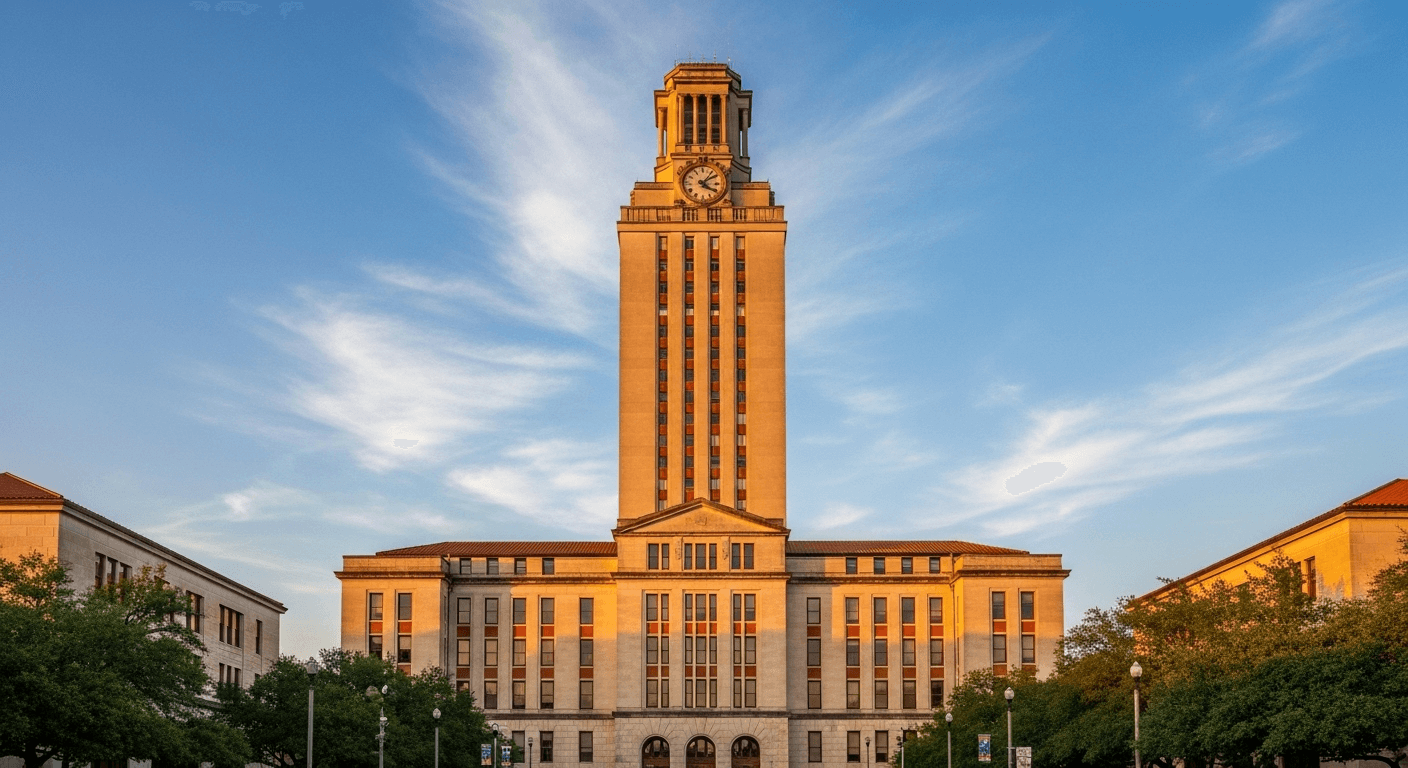
UT Austin · Computer Science admission
UT Austin Computer Science Admission
UT CS direct-admit acceptance rate is approximately 5-8% overall (4-7% for non-residents). Approximately 350-400 freshmen admitted per year. Admitted profile: 4.0 unweighted GPA, top 1-3% class rank, SAT 1500-1560, substantive programming portfolio, multiple AP STEM courses with 5s. The Turing Scholars research track within CS is even more selective. Internal transfer to CS from other UT colleges is approximately 5% acceptance rate.
UT CS admission selectivity
| Metric | Value | Notes |
|---|---|---|
| Direct admit acceptance rate (overall) | ~5-8% | ~350-400 admits from ~5,500-6,500 apps |
| Direct admit acceptance rate (non-resident) | ~4-7% | 10% non-resident cap applies |
| Turing Scholars acceptance | ~5-8% | From CS-admitted student pool |
| Internal transfer to CS | ~5% | 15-25 transfers/year from 300-400 apps |
Admitted UT CS student profile
- Unweighted GPA: 4.0 (or maximum the high school allows)
- Class rank: top 1-3% of class
- SAT: 1500-1560 (middle 50%)
- ACT: 34-36 (middle 50%)
- Course rigor: highest available; AP Calculus BC, AP Physics C, AP Computer Science A, AP Chemistry/Biology all common; post-AP math courses (Multivariable Calculus, Linear Algebra, Discrete Math) when available
- Math competitions: AMC 10/12 high scorers, AIME qualifiers, USAMO/USA Computing Olympiad participants are common in the admitted pool
- Programming: independent projects with substantive code (not just tutorials), GitHub portfolio, USACO performance, hackathon wins
- Research: some admits have completed independent or faculty-mentored research
What UT CS admissions wants
Demonstrated technical depth
UT CS admissions reads for substantive programming experience, not just stated interest. Strong applicants have built something real: a published mobile app, an open-source library with users, a working machine learning model, a competitive programming track record, or substantive research. Self-reported "passion for CS" without evidence does not get admitted.
Math foundation
UT CS at the upper-division level is mathematically rigorous (algorithms, theory of computation, advanced math). Strong applicants demonstrate math foundation: AP Calculus BC with 5, AP Statistics, AMC/AIME participation, post-AP math courses, or independent study in higher mathematics. Math weakness is a near-disqualifier for direct CS admission.
Intellectual curiosity about CS as a discipline
UT CS values students who care about CS as a field of study (algorithms, theory, AI research, programming languages, systems) not just as a path to a tech job. Strong essays demonstrate curiosity about specific CS subareas, faculty research interests, or open problems in the field.
Realistic understanding of the program
Successful CS essays show the applicant understands what UT CS involves: the curriculum, the research labs, the Turing Scholars program, specific faculty whose work interests them. Generic essays about "CS at any top school" are immediately less competitive.
The Turing Scholars research track
Turing Scholars is UT CS' research-focused honors program. After UT CS admission, the program identifies candidates from the admitted pool based on academic profile and research orientation.
- Size: ~20-25 students per cohort
- Selection: by invitation; no separate application; selection based on CS application materials
- Curriculum: CS major + research-track honors courses + faculty mentorship + thesis option
- Distinctive features: direct PhD pathway (MIT, Stanford, CMU, Berkeley placement); accelerated coursework option; research stipend
- Common profile: 4.0 GPA, SAT 1540+, significant prior research or competitive programming
UT CS major and curriculum
The UT CS curriculum covers the core CS canon plus depth in upper-division electives:
- Lower-division core: Programming I and II, Data Structures, Discrete Math, Calculus 1 and 2, Linear Algebra
- Upper-division core: Algorithms, Operating Systems, Computer Architecture, Programming Languages, Theory of Computation, Networks
- Electives: Machine Learning, AI, Computer Graphics, Security, Compilers, Distributed Systems, Databases, Software Engineering, plus seminar courses
- Research opportunities: Freshman Research Initiative, faculty research labs (UT CS has labs in AI, graphics, programming languages, theory, systems, security, ML)
- Capstone: senior thesis option for Turing Scholars and other interested students
Pathways for students who don't get direct CS admission
- Internal transfer to CS: enter UT in Natural Sciences or Liberal Arts; complete CS prerequisites (Programming I and II, Discrete Math, Calculus 1 and 2) with 3.95+ GPA; apply for internal transfer after freshman year. Acceptance rate ~5%.
- UT CS minor or pre-CS major: some UT students complete CS coursework as a minor or as part of another major (Math, Statistics, Physics). The Department of Statistics and Data Science offers a Data Science major that overlaps significantly with CS.
- Transfer to UT CS from another university: attend a Texas community college or another university; complete CS prerequisites; transfer to UT CS after sophomore year. Transfer acceptance rate ~5-10%.
- Consider other strong Texas CS programs: UT Dallas CS, Texas A&M CS, Texas Tech CS, Rice CS are all strong options with more accessible admission. Some students complete a CS bachelor's elsewhere and pursue UT for graduate school.
UT CS career outcomes
UT CS produces some of the strongest tech career outcomes of any US public university:
- Median starting salary: $115,000-$140,000 base
- Signing bonuses: $20,000-$50,000 typical
- Equity grants: $50,000-$200,000+ over four-year vesting (varies by company)
- Top employers: Google, Meta, Apple, Amazon, Microsoft, Stripe, Palantir, Tesla, Nvidia, AMD, Indeed, Bumble, Indeed
- Quant trading recruiting: Jane Street, Citadel, Two Sigma, Susquehanna, DRW (high compensation, increasingly active at UT CS)
- PhD placement (Turing Scholars track): MIT, Stanford, CMU, Berkeley, Princeton, UT, plus top European programs
The four-year cost picture for non-resident CS admits
CS cost with residency pathway
Out-of-state CS direct admit faces year 1 tuition of $53,500. With the Texas residency pathway pursued during year 1 and approved for year 2, tuition drops to $15,300/year for years 2-4, saving approximately $38,200/year. Four-year tuition with pathway: ~$99,400, vs without pathway: ~$214,000. Savings: ~$114,600 over four years.
Frequently asked questions
What is the UT Austin Computer Science acceptance rate?
What GPA does UT CS require?
What SAT/ACT score does UT CS require?
What CS experience does UT CS admissions want?
What is Turing Scholars at UT CS?
Can I get into UT CS without a perfect academic record?
Is UT CS worth out-of-state tuition?
What is the internal transfer rate to UT CS?
Talk to Luke
Your situation is specific. Get a written answer.
The site covers the general case. If your circumstances do not quite fit — divorce, military, scholarship interactions, late timing, prior denial — send a message. Luke replies personally, usually within one business day.
Or send a message and Luke will reply in writing: